| 英文摘要 |
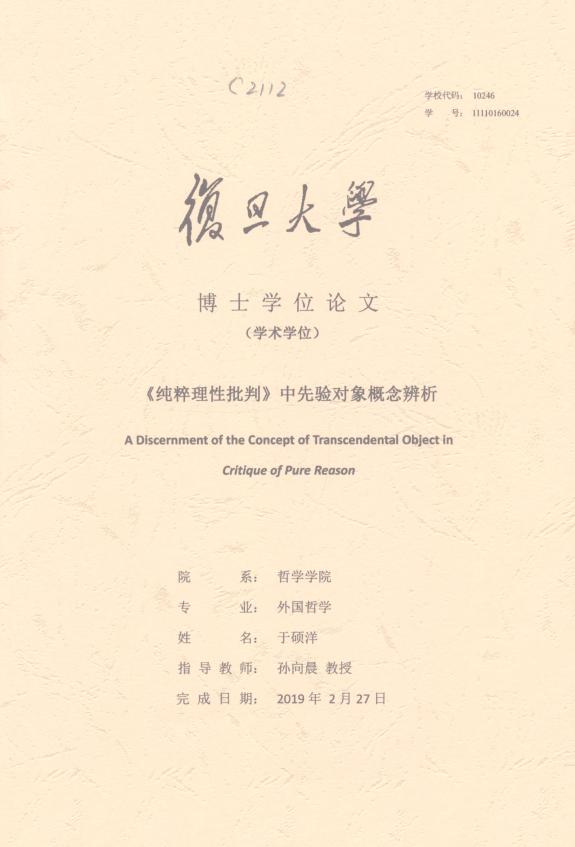
Kant's "Copernican Revolution" requires that objects must conform to the transcendental knowledge, i.e., the knowledge can make determinations of the empirical appearances before they are given; and that the knowledge about the objects must be a priori synthetic. In order to accomplish these tasks, we have to postulate an object which both can a priori stand for empirical appearances, and can play a critical role in the connection of various elements of the transcendental knowledge so that the a priori synthetic judgments about the empirical appearances are made possible. Against such a theoretical background stands the importance of the Concept of Transcendental Object out. However, Kantian scholars do not attach due importance to the concept. In ordinary understanding, the Transcendental Object (Gegenstand) concept (hereafter referred to as TOG) is identified with the Transcendental Ob-ject (Objekt) ((hereafter referred to as TOO), and both of them are further identified with the Thing- in -itself. In contrast to such a reading, this paper intentionally adheres to the meaning of CPR and discriminates the concept as such from other concepts in terms of denotation. Under the intellectual guidance of such Kantian experts as H. J. Paton, Graham Bird, and Henry Allison, this paper, targeted at the clarification of the TOG, unfolds its conceptual discrimination from four aspects; namely, they are the 1〓 edition of TD, the Transcendental Idealism, the Empirical Realism, and the 2〓 edition of TD. Kant elaborates on the TOG in detail in the 1〓 edition of the Deduction of the Pure Concepts of Understanding (hereafter referred to as TD) in Critique of Pure Reason (hereafter referred to as CPR). The TOG in the 1〓 edition can be understood as an object of representations a priori, and it signifies the possible empirical manifold combined a priori in a synthetic unification. The connection between TOG and the transcendental apperception makes the synthetic unification possible and brings the objectivity to the empirical manifold. Meanwhile, the TOG, an a priori concept of object, does not contain any empirical manifold of sensibility; it is non-empirical, but, even on this basis, the TOG can't be misunderstood as Thing-in-itself. The emphasis of TOG concept is laid on "transcendental". In Kantian sense, the "transcendental" concept emphasizes the knowledge of the "cognition of possible object a priori". In association with the Kantian transcendental knowledge and transcendental reflection, the paper argues that the "transcendental" concept should be understood on the epistemological, rather than ontological, perspective. In this sense, the TOG does not refer to an entity which ontologically exists. On the contrary, it is a theoretical postulation which helps to recognize various cognitive abilities related to the transcendental knowledge and to delimit the scope, boundaries, and objective validity of transcendental knowledge in the field of epistemology. In the Transcendental Idealism, the TOG concept tangles in greater degree with the Thing- in- Itself and the TOO. In this regard, this paper refutes, in the first place, the proposition traditionally accepted as "the Thing-in- Itself originates the affection of sensibility." Then, based on the Two- Aspect View of epistemology, this paper defines the core meaning of the Thing- in- Itself as Noumenon in the negative sense. Concisely, the Thing- in- Itself and the Appearance are not so two distinctive entities as two different aspects of one and the same one empirical appearance. The Thing- in-Itself concept alerts us that the transcendental knowledge can't step over the boundary of empirical appearance for the sake of itself. After the above clarification, the Thing-in- Itself concept clearly discriminates from the TOG. In addition, the TOO concept has two-fold meanings. On one hand, TOO is close in meaning to TOG, both of which signify, in association with the transcendental apperception, the combination of the possible manifold of sensuous intuition. On the other hand, in particular on the basis of the Transcendental Dialectic, TOO can be interpreted as the Thing- in- Itself concept in the positive sense; i.e., it serves as the cause of or lays the foundation for empirical appearances. Faced with these paradoxical interpretations, this paper upholds the Kantian constitutive and regulative principles of Reason in the interpretation. In the theoretical application of Reason, Kant, on the basis of the constitutive principle, stresses the transcendental understanding of the empirical appearance; and accordingly, establishes the epistemological connection between the TOG and the empirical appearance. In this sense, TOG and TOO are close in meaning. However, in the practical application of reason, Kant, on the basis of the regulative principle, interprets the TOO as the transcendental cause of appearance in the system of reason; in this sense, TOO discriminates from TOG. An empirical realist has to directly admit the existence of matter of empirical appearance. For this sake, the "reality" should be distinguished from the "actuality". What the empirical realist really cares about is the matter which actually exists in experience. The matter of appearance can empirically affect the senses and then the mind can receive the real representation about the existence of the said matter. Substance is another key concept which is closely related to the matter of appearance. Kant recognizes the permanent individual entity of empirical appearance as the relative substance; but more essentially, the permanent quantum of matter which is contained in the individual appearance is the absolute permanent substance. Moreover, because the substance concept concerns the existence of matter of appearance, the Inherence-- Subsistence category can't be used a priori to directly determine the existence of matter of the empirical appearance. We can only turn to the empirical analogy to indirectly deduce the permanent substance of the appearance matter. After the discussion about the matter and substance in relation to the real experience, this paper can elucidate the meaning of TOG more clearly. The TOG signifies the possible manifold of sensibility combined in the synthetic unification; but the existence of matter and the relationship between different entities (such as substance and its attributes) cannot be totally determined a priori. Rather they can only be determined in experience. In this sense, although the existence of matter and the relationship between different entities both belong to the realm of appearance, such empirically permanent entities as the existence of matter or substance cannot be combined a priori in the possible object of experience. The possible manifold of experience combined in the TOG can be no more than the sensation in general. The last section of the paper body is about the relationship between the 2〓 edition of TD and the TOG. The deduction of the 2〓 edition initiates from the transcendental apperception concept which can only be correctly interpreted on the basis of its formality, self-identity, and the "objectivity" in the relevant objective reality. In the transition from apperception to imagination, the productive imagination is brought forward, which combines, on the transcendental level, the possible manifold of representation. In the 2〓 deduction, it is the object of the senses in general that is combined by the productive imagination and that can represent a priori the manifold of empirical appearance. The analysis is further extended to the locality of the object of senses in general in the 2〓 edition, to its relation with the transcendental apperception, and to the objective reality it brings to the transcendental knowledge. All these properties are almost the same as those of the TOG in the 1〓 edition. This comparison proves that the TOG still retains its crucial locality in the 2〓 edition deduction, though its literal expression can't be directly found in the 2〓 edition; and the object of senses in general is clearer in meaning and is the same as TOG. All in all, after the analyses are made in the meaning of TOG in the 1〓 edition of TD, in the comparison with the Thing- in- Itself and TOO in Transcendental Idealism, in the relationship between TOG and the sensation in general brought forward by the real matter and substance in the Empirical Realism, and in the identity with the object of senses in general in the 2〓 edition of TD, we finally elucidates the meaning of TOG: TOG is not thing-in-itself and, in most contexts of CPR, differs from the TOO equivalent to thing-in-itself in the positive sense. In the epistemological reading of the paper, TOG can a priori stand for the manifold of sensibility, can be synthesized into a figure of an object by the productive transcendental imagination, and can, in connection with the apperception, signify the synthetic unification of the possible empirical manifold. In this sense, the clarification of the meaning of TOG is indispensable for the tenacious grasp of the Kantian Critical Philosophy. Key words: Transcendental Object (Gegenstand), Transcendental Ob-ject (Objekt), thing-in-itself, Transcendental Idealism, Transcendental Apperception. CLCN: B516.31
|